This is the first article in the series “Serious Analysis of Game” that I just start writing. As the book “The Art of Game Design” said, game designer give players an experience, and this experience could vary among players. If we try to ignore subjective feeling from different players, we can actually understand what the designer want us to feel. I am now trying to find a way that best describe the experience we get when playing a game and the goal of designers. I’ll write about game in these parts: mechanics, art, narrative, and audio. By that, I hope I can let you have a deeper understanding on why the game works or not, and eventually be more skillful when designing your game. The first game I pick for this series is GRIS, a platformer game released in 2018. In this article, I’ll only analyze its mechanic and leave other parts for next time.
First, I will define “mechanic feature” or just “feature” as a distinctive part within a specific mechanics. For example, when the the player learned how to swim, the depth they can dive into the water depends on the height they jump, and it does not change even if they jump as a stone. That is a mechanics feature, and I classify it this way because puzzles are constructed to challenge player’s understanding and skill in mechanics feature. When a new mechanic feature is introduced, various puzzles will followed with rising difficulty. Sometimes its the reverse way where puzzles come first and new features introduced later so the player can solve puzzles that block their way.
If you haven’t notice, most important difference between GRIS and most of other platformer games is that the player will never die or stuck. There is always a platform that catch player when they are falling and no matter how they messed up, there’s always a way back. Some levels are design to let player think they will die if they fall, but actually it’s just designer restricting the camera position, and a platform is in below. It effectively alleviate player’s mental stress and lower the difficulty.


However, it does not make the game as simple as a walking simulator. Consider about other platformer games where you are defeated by enemies and you are revived and go challenge again. The process is similar as you missed a jump and have to do it over. They are all challenges or puzzles that designer want player to experience for various reasons, maybe to practice their skills or increase the design diversity so the level is not boring. It’s just their puzzles focus on different parts so that letting player die has no meaning in GRIS.
Since there’s no skills and enemy, environment become a main part to adding variations and create more diverse experience. Water is added in the middle of the game and at first player can only float on it. It makes player moves slowly and slower if they jump. But later when player can dive and dash, moving in water become more comfortable than on the ground. From then on, water of different shape starts to appear, like water square, water in middle of air, and so on. They make water a comfortable medium where player can move freely.
With that said, puzzles are set up to challenge player’s understanding of features, and puzzles can be mandatory or optional. Mandatory puzzles are there to help player learn necessary skill to continue the level, like you need to learn and practice basic arithmetic operations before learning equations. Here are few examples: after player learned the stone skill, they have to turn into a stone and walk pass a gust, and the gust will always take player back to the start position whereas player can still move forward with gust before learning the skill.

It’s worth noting that the player is not required to master the skill, but only need to use it at right time. The threshold for jumping, for instance, is pretty low, meaning you don’t need to jump at right time and position to reach the platform, though the threshold is gradually change to increase the difficulty of the game.

On the other hand, optional puzzles can give player more choices, it’s like two ways to solving a problem, one require deeper understanding to concepts and done in one step, the other need lots of steps but easier to work with. Another purpose for optional puzzles is to allow player to further challenge themselves, like achievements or so. GRIS use optional puzzles mainly for achievements since it has linear structure of levels. It’s important to understand that you can’t force player to experience anything, and whether player want to go for extra challenge depends on them. Designer can use rewards attract more players for challenge, but GRIS did not do that for mementos, which means they made mementos primarily to cater to players who seek more challenges and achievements.
As mentioned, mementos are challenges that can be complete by touching a specific point. They typically require player to going backward after they get certain ability, be skilled enough to perform certain tasks in limited time, or discovering the edge or hidden spots of a scene.

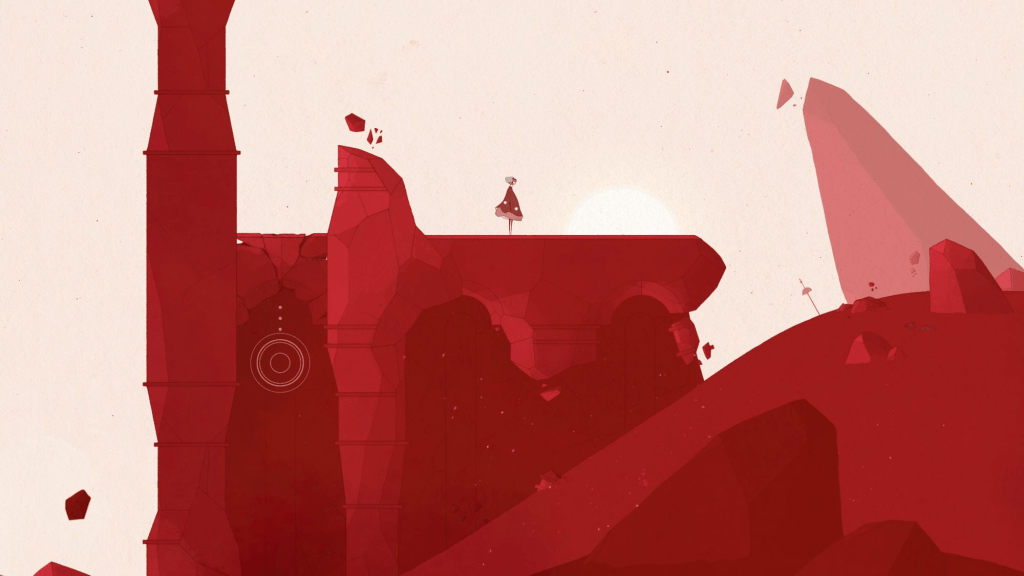
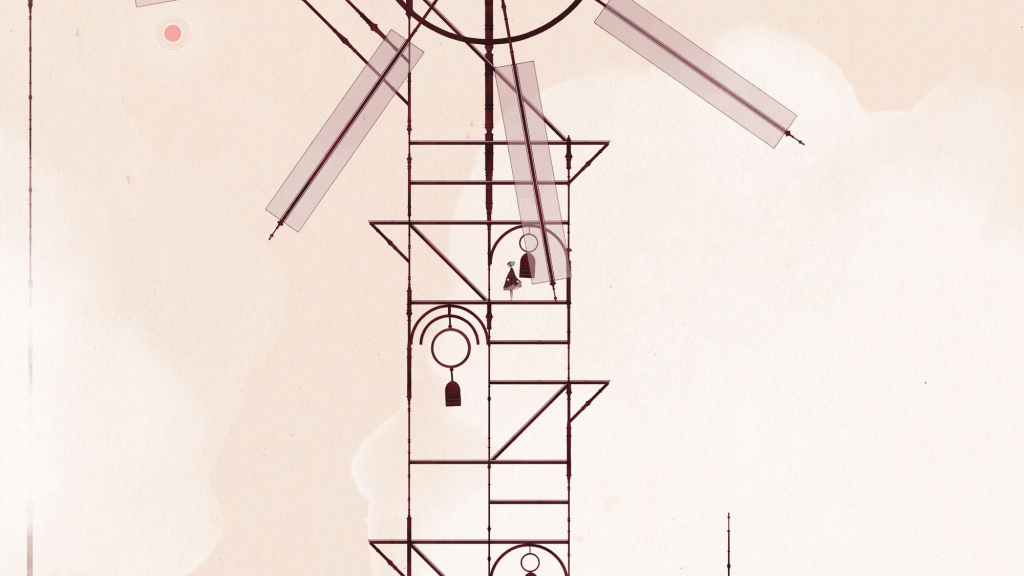
In the game, you can see the only tip is which button you should press to use certain ability. Non of the challenges in game have tutorial written in words that tells you what is it and how to finish the challenge. Instead, most mechanics are conveyed through environment, such as windmills start to spin when gust is about to come, while the windmill inside shelter does not spin, indicating the cave is shelter. Nearly all challenges are well designed to make the difficulty curve of the game slowly rising with some peaks, but doesn’t end so high. Here we can see designers want players to finish the game with relatively relaxing emotion but not too relaxing to feel boredom. It’s a great way to immerse players in game and let them enjoy the art and story with more focus.

Although most challenges are designed well, we can still find some flaws. As a 2D platformer game, leveling the platforms is crucial. Whatever the art it has, player should be able to distinguish different platforms and background. GRIS has integrate its art style to platforms pretty well, but still failed in some parts. For instance, player can drop from a thin platform only if the platform below it is close by (based on what I tried). And there’s even a puzzle involving not be able to drop from a slightly high platform. It could confuse the player since they are constantly jumping from high altitude. Another example of not separating background and platform well is the cave challenge in forest.
To summarize, we can learn several points from the mechanics design of GRIS: First, consider what mechanic feature you give to player, make sure they distribute reasonably and are challenged accordingly. Second, make sure you considered both mandatory and optional challenges, whether to have them and the reward for them will vary based on your game’s structure. Finally, always keep in mind the key experience you want players to have.
So that’s all analysis on mechanics. Please remember that this is a game analysis, not a game review, and its purpose is to figure out what designers want us to experience and whether it works. Although, inevitably, the analysis may contain my subjective feeling that only few people have, I hope the conclusion I come up can help you better understand the game design.
 Xiao Jiang - Brian
Leave a comment